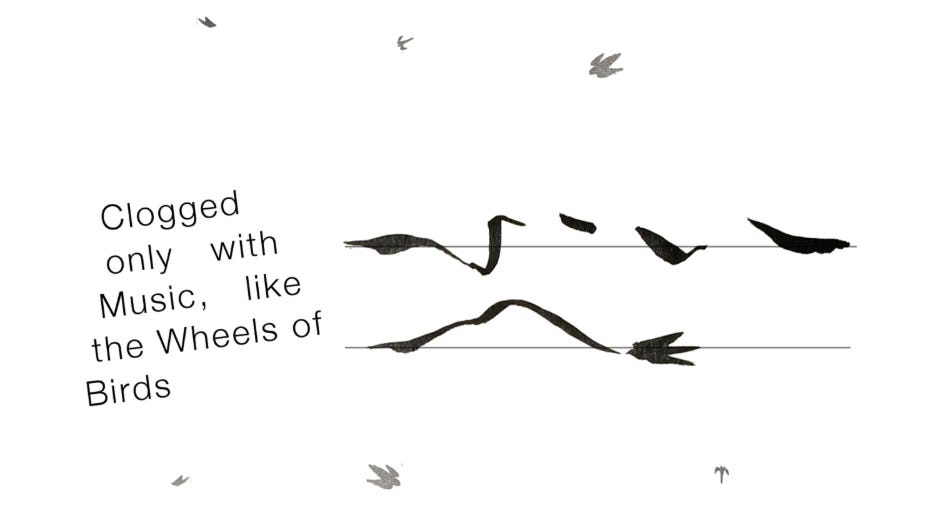
‘Breath – and I –’
Reimagining 'my little Force explodes' for Quiet Music Ensemble
“This, again, invites reflection about communication: for Murray cannot communicate widely or precisely by means of vague notation, just as Dickinson could not have expected to communicate widely or precisely even by means of the hand-bound fascicles of heavily- and mysteriously-annotated texts that went on to become her central corpus – but clearly Dickinson did so anyway; and so we are led to wonder whether Murray, in her turn, might be communicating to us more effectively than is immediately obvious.” - James Camien McGuiggan, The Journal of Music
This weekend (18/19 April), Quiet Music Ensemble will perform two concerts in Estonia as part of Estonian Music Days in a programme that will include premieres of new works by Liisa Hõbepappel and Märt-Matis Lill, music by Karen Power, and a new version of my own my little Force explodes.
my little Force explodes, commissioned in 2019 by Ergodos and New Music Dublin, and released on ‘LIT’ EP by Ergodos last year, is a ritual of letter-opening, communication, message and longing, based on the envelope poems of Emily Dickinson. It was originally formulated for two performers (Michelle O’Rourke + Lina Andonovska) locked in a kind of asynchronous conversation - the players play facing each other, they breathe together, but they ‘speak’ separately, quietly broadcasting their obstruse messages through the ether to be received or to dissipate. There is also distraction - theatre - as the players also open their paper envelopes, themselves a reminder of the physical and emotional act of writing and containing and sending and keeping, containing their private notes. They at once support and ignore each other, listen and speak.
The delight and curiosity of working with graphic and open scores is the many paths realisation can take. This means an ensemble like QME can take the same core material and respond to it in a vastly different way; but first this needed some reflection on how an ensemble might take on the dialogic roles of the original duo. How does an ensemble communicate without crosstalk? How does it receive those (un)-intelligible messages? How do its components, individual musicians, listen supportively, while responding to their own messages?